

Bank Loans for Foreigners Buying a House in Japan: With and Without Permanent Residency
Bank Loan Conditions for Foreigners Buying a Home in Japan: With and Without Permanent Residency
Owning a home in the land of the cherry blossoms is a major milestone that affirms the stability of life and career for Vietnamese people living in Japan. However, the cost of buying a home is far from small, and most of us need financial support from a bank. So how does the home-buying process in Japan actually work? How can you get approved for a Japanese bank loan at the most favorable interest rate?
This article breaks down in detail the conditions for a home loan (住宅ローン) for two specific groups: those who already hold permanent residency, and those who don't.
1. The Nature of Home Loans (住宅ローン) in Japan
Before getting into the details, you need to understand that Japanese banks are extremely cautious when disbursing loans. They don't just look at the value of the property — they also assess the level of risk and the borrower's long-term ability to repay. For foreigners in particular, the factor of “commitment to staying in Japan long-term” is always weighed heavily.
2. Common Ground for All Borrowers at Japanese Banks: The “Unwritten Rules”
Whether or not you hold permanent residency, to pass through the screening process at Japanese banks, you must satisfy the following baseline conditions:
• A clean tax payment history: You must provide a certificate of tax payment. Any history of late tax payments, tax evasion, or unpaid pension (Nenkin) contributions will result in immediate rejection of your application.
• Stable income and length of employment: Banks typically require that you've worked at your current company for at least 1 to 3 years (a small number of banks accept 6 months if the company is large). A stable income of at least 3 million yen or more.
• A “clean” credit history: You must have no record of bad debt, unpaid phone bills, or late credit card payments. If you've been late on credit card payments too many times, your credit score at CIC (the credit information center) will be negatively affected.
• Age requirements: Generally between 20 years old and under 65 at the time of borrowing, with the loan fully repaid before age 75 or 80.
• Health condition: You must be eligible to enroll in group credit life insurance, Danshin (団体信用生命保険) — a type of insurance that pays off the remaining loan on your behalf in the event of a major health issue or death.
3. The Key Difference: Group WITH Permanent Residency vs. Group WITHOUT Permanent Residency
The decisive factor that creates a difference when borrowing from a Japanese bank is your visa status.
3.1. The group WITH permanent residency: “The door is wide open”
If you already hold a permanent residency card, congratulations! Essentially, your loan conditions and benefits are completely on par with those of a Japanese citizen.
• Maximum loan ratio: You can borrow up to 110% of the property value (including the costs of registration and other procedures).
• Preferential interest rates: You'll get the lowest rates available in the market (current floating rates start from as low as 0.9%, depending on the bank).
• A wide range of bank choices: You can freely apply to major banks (megabanks) such as MUFG, SMBC, and Mizuho, as well as online banks offering excellent rates such as SBI Shinsei and au Jibun Bank.
3.2. The group WITHOUT permanent residency (engineer visas, business visas, highly skilled professional visas, etc.)
Can you buy a home in Japan without permanent residency? The answer is YES, but the conditions are much stricter, since banks are concerned about the risk of you returning to your home country partway through the loan term.
• Down payment requirement (頭金): Most banks will require you to pay 10% to 20% of the property value upfront yourself. Very few banks lend 100% without permanent residency (currently SMBC and Suruga offer 100% financing).
• Limited number of lending banks: The number of banks that accept applications from non-permanent residents is fairly limited. Some familiar names that support this group include SMBC, MUFG, and Suruga.
• Requirement for a guarantor or marriage: Some banks will only approve an application if you have a Japanese spouse, or a spouse with permanent residency, acting as a guarantor (or co-borrowing through a “Pair Loan”).
• Higher interest rates: To offset the risk, the interest rates applied to non-permanent residents are usually higher than those for permanent residents (depending on the application).
💡 A positive note: If your application is strong (high income, a large publicly listed employer, stable employment, a healthy account balance, etc.), you can still get 100% financing at rates comparable to those offered to Japanese citizens or permanent residents. |
4. Overview Comparison Table of Loan Conditions
Comparison Criteria | Group WITH Permanent Residency | Group WITHOUT Permanent Residency |
Maximum loan ratio | Up to 110% (full loan amount + related costs) | Typically only 80~90% (SMBC and Suruga offer 100% depending on the application) |
Average interest rate | Lowest available at current market rates | Average to high (very strong applications may still get low rates) |
Bank options | All banks in Japan | Limited (only a select number of designated banks) |
Employment requirements | 1~3 years at current company | Generally stricter, with preference for large companies |
5. The Latest Updates to Japan's Land Law and Tax Policy (2026)
If you're planning to go through the home-buying process in Japan this year, there are two important legal and tax updates you shouldn't overlook:
5.1. Stricter requirements for registering inherited land
Under the latest law now in widespread effect, registering the transfer or inheritance of real estate has become mandatory. If you buy an older home or a plot of land without completing this registration clearly, you could face heavy administrative fines. This makes the market more transparent, but it also means legal document checks during a home purchase must be carried out with extreme care.
5.2. Changes to the home loan tax deduction policy (住宅ローン控除)
The income tax refund policy for home loan borrowers is still in effect, but the energy-efficiency standards required of a home have become stricter. The more environmentally friendly a home is, the higher the cap on the tax refund. Conversely, if you buy an older home that doesn't meet insulation standards, the amount of tax refunded will be significantly reduced.
6. The Standard 5-Step Process for Applying for a Bank Loan and Successfully Buying a Home
To make the approval process go smoothly, you should be familiar with the following roadmap:
STEP 1 Preliminary Screening (事前審査 - Jizen Shinsa) Done online or through a real estate agency to find out whether the bank is willing to lend to you. Timeframe: 3~7 days. |
STEP 2 Find a Home and Sign the Sale Contract (売買契約) After passing the preliminary screening, you proceed to finalize the home you've chosen. |
STEP 3 Formal Screening (本審査 - Hon Shinsa) The bank conducts a detailed appraisal of the property and a thorough review of your personal application. Timeframe: 1~2 weeks. |
STEP 4 Sign the Loan Agreement (金錢消費貸借契約) Formally sign the agreement covering the interest rate terms and loan duration. |
STEP 5 Disbursement and Handover (引き渡し) The bank transfers the funds to the seller, you receive the keys, and begin your journey of monthly repayments. |
Conclusion
Buying a home in Japan isn't difficult if you clearly understand where your application stands and prepare a smart financial roadmap. Whether or not you hold permanent residency, the opportunity to own a home in Japan remains wide open, as long as you know how to choose the right bank and the right partner to guide you through the process.
Not sure how much you can borrow based on your income? Struggling with translating your documentation for a Japanese bank?
👉 Leave your contact information today or reach out to ESTATE PLUS to get free guidance from real estate experts who deeply understand the market and can help you map out your loan application journey!
This article is for informational purposes only, compiled based on common regulations and loan conditions at Japanese banks. Actual conditions, loan ratios, and interest rates may vary depending on the bank, the timing, and the individual applicant. Please contact a bank directly or a consultant for accurate confirmation before making any decisions.
Related Posts
View all in this category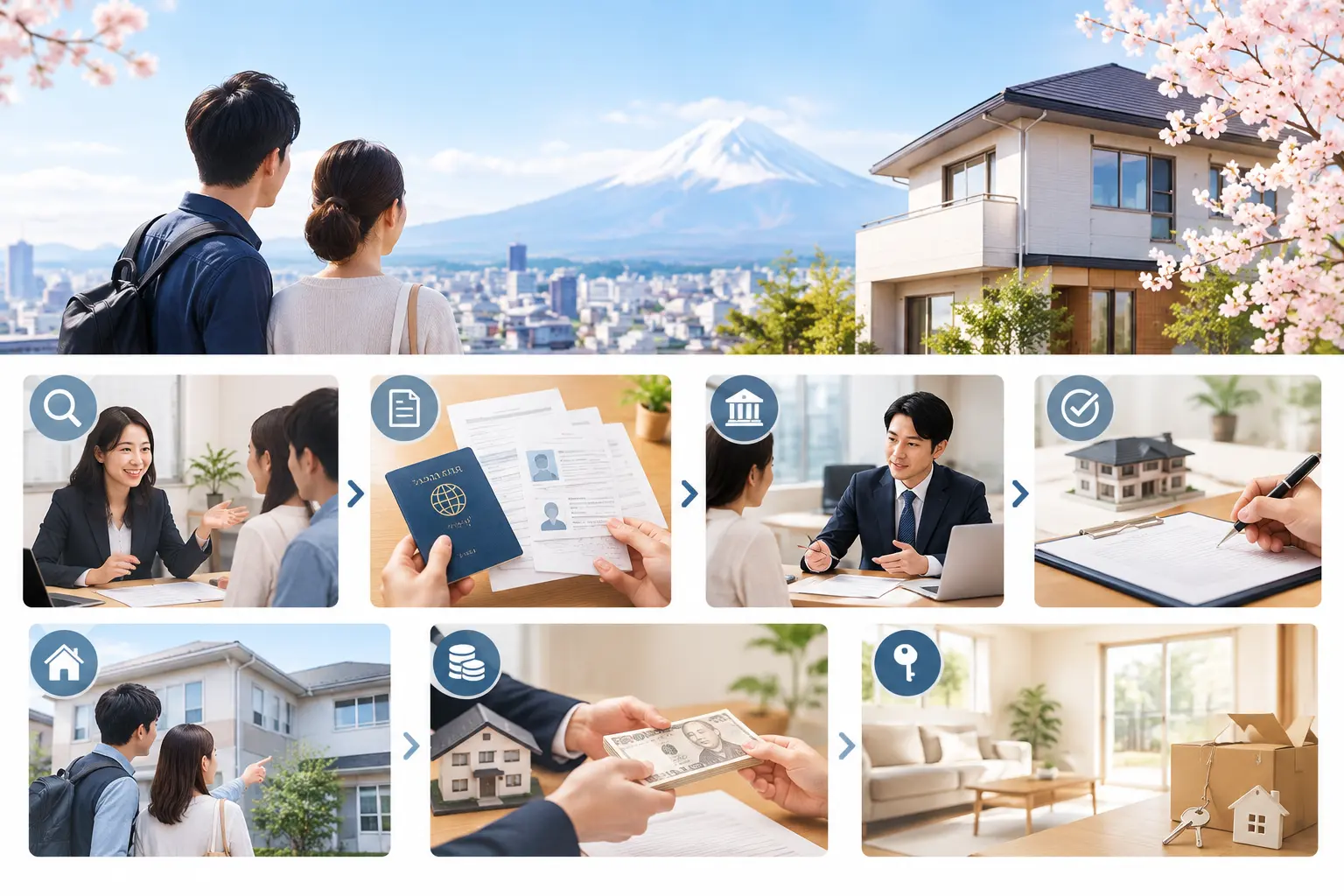
Step-by-Step Guide to Buying a House in Japan for Foreign Residents
Are you living and working in Japan, dreaming of owning your own home? The process of buying propert...
Cost of Buying a House in Japan: Besides rent, what other expenses do you need to prepare?
Buying a house in Japan, in addition to the rent, you need to prepare an additional 6-10% of the hou...
CONDO OR DETACHED HOUSE? A Detailed Comparison Before Buying Property in Japan
Which is right for you - a CONDO or a HOUSE? Compare management costs, appreciation potential, and p...