
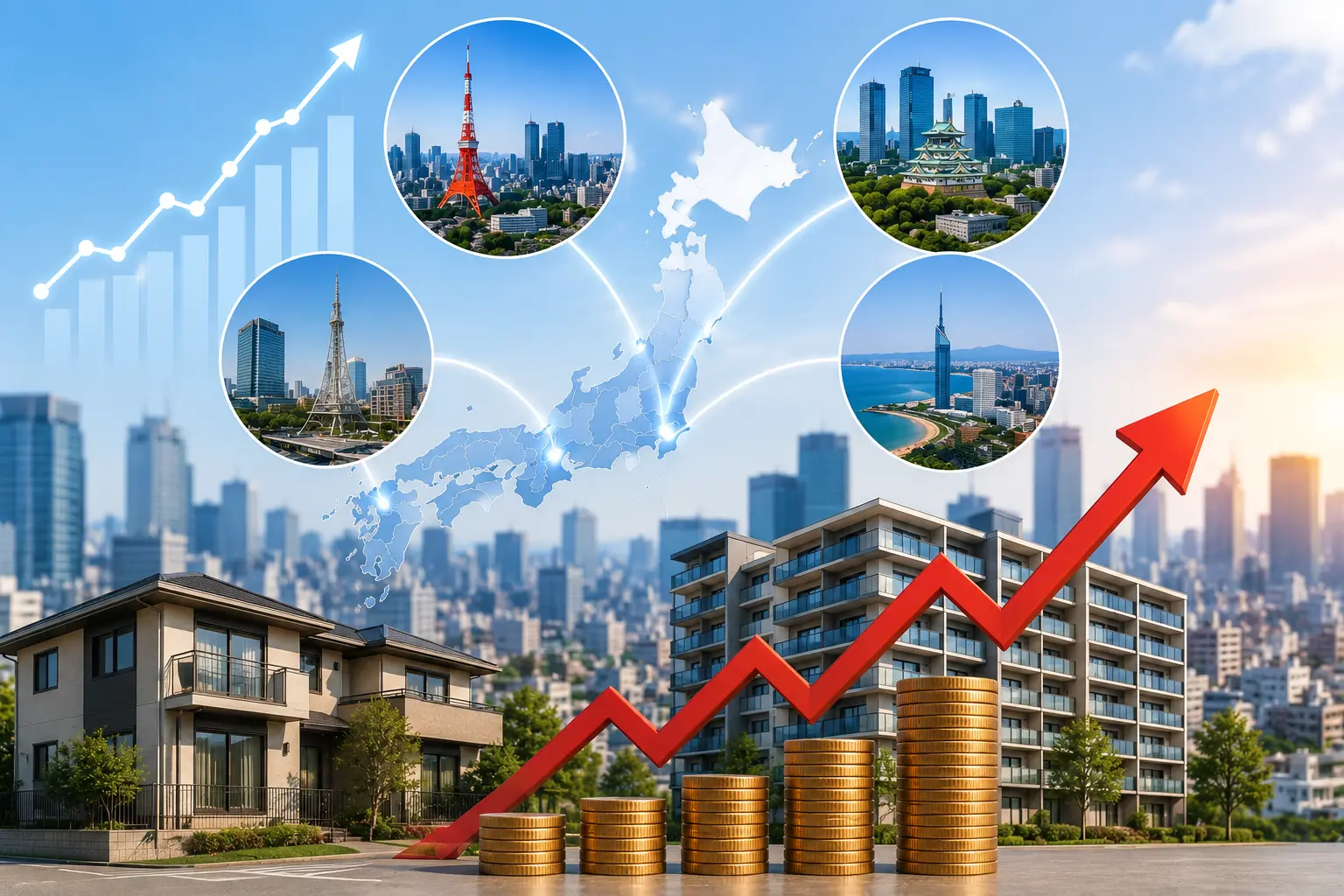
Tokyo, Osaka, Nagoya, Fukuoka Housing Prices in 2026: How Much Longer Will They Keep Rising?
ESTATE PLUS
Updated 2026 property prices in Japan's four major cities: Tokyo, Osaka, Nagoya, and Fukuoka. An analysis of price trends and the risks to watch
Japan's real estate market is going through its longest and strongest period of price growth in years. According to the Published Land Price (公示地価) announcement by Japan's Ministry of Land, Infrastructure, Transport and Tourism (MLIT) on January 1, 2026, the nationwide average land price rose for the 5th consecutive year, with residential land prices having risen continuously for 12 years.
In this article, ESTATE PLUS will walk you through an updated overview of property prices in the country's four largest markets: Tokyo (23 central wards), Osaka, Nagoya, and Fukuoka — along with the factors shaping their growth potential going forward.
1. Tokyo's 23 Wards: New Condo Prices Surpass 100 Million Yen, But Has Growth Cooled?
Tokyo's 23 central wards remain Japan's hottest market. Residential land prices here rose by an average of +8.99% in the early-2026 announcement period, and notably, no ward saw a price decline — all 23 wards recorded positive growth.
In terms of condo prices, the market hit a memorable milestone: the average sale price of new condos in the 23 wards surpassed 100 million yen and has remained above this threshold continuously since May 2024. Resale condos (previously owned units) have also accelerated, rising from around 50 million yen at the end of 2024 to nearly 80 million yen by November 2025.
However, Q1 2026 data shows signs of cooling: the pace of price growth for resale condos in the 23 wards has slowed compared to previous quarters, ceding the lead in growth speed to the Osaka market. Still, in terms of cumulative price growth since initial sale, condos in the 23 wards recorded an average increase of up to +117.7% over their original launch price — the highest among Japan's major cities.
Main drivers in Tokyo
• A decline in new condo supply has left the market short on inventory, while genuine demand remains strong thanks to buyers who can still afford homes under 100 million yen.
• Wariness toward older homes has also eased significantly: according to a survey by the National Real Estate Brokers Association, more than 54% of respondents said they no longer hesitate to buy a previously owned home if it's in good condition.
2. Osaka: Price Growth Rate Surpasses Even Tokyo in Q1 2026
If Tokyo holds the highest cumulative price increase, Osaka is the market with the fastest price growth rate in Q1 2026, overtaking Tokyo's 23 wards.
Notable points in Osaka
• Resale condo prices across Osaka Prefecture have risen 66.3% compared to 9 years ago (as of January 2026), with an average unit price of about 520,000 yen/m².
• Kita-ku (北区) leads the 9-year growth with +132.4% — a figure approaching the growth rate of Minato-ku (港区), Tokyo's most expensive ward.
• Chuo-ku (中央区), which includes the Namba, Shinsaibashi, and Honmachi areas, ranks 2nd with growth of +90.9%.
• The “6 central wards” group (Kita, Chuo, Tennoji, Nishi, Fukushima, Naniwa) has notably higher unit prices than the overall average and faces less risk of price decline thanks to transit advantages and urban redevelopment projects.
Compared to Tokyo, Osaka's population and economic scale aren't as large, but its price growth is closing the gap, reflecting capital shifting toward seeking better returns in Japan's second-largest metropolitan areas.
3. Nagoya: Stable Growth, But Showing Signs of Slowing
The Nagoya metropolitan area (名古屋圏) is one of Japan's three major metropolitan areas (alongside Tokyo and Osaka), and continues to record land price growth for the 5th consecutive year. However, MLIT's 2026 land price report notes that growth momentum in this region has shown signs of slowing compared to the other two metropolitan areas.
In Aichi Prefecture, the ward with the highest land prices is Nakamura-ku (中村区) in Nagoya, with growth of +4.70% year-on-year.
In terms of condo prices, the Nagoya market shows stability rather than a boom: the average price of a resale condo (70m²) rose from about 20.59 million yen (2016) to 29.07 million yen (2025), equivalent to an average annual growth rate of about 5% over 10 years, with 2022 recording the sharpest single-year increase (nearly 2 million yen in just one year).
Compared to Tokyo and Osaka, Nagoya is a market with a lower growth margin but also more stable and less prone to sudden corrections - well-suited to investors who prioritize safety.
4. Fukuoka: A Market Driven by Population Growth, Not Speculation
Fukuoka tells a different story from the other three cities: its growth momentum comes mainly from population growth, rather than speculative capital flows.
Key figures in Fukuoka
• Residential land prices across Fukuoka Prefecture rose by an average of +3.7% in the Q1 2026 announcement, marking the 12th consecutive year of price growth. All of the nationwide top 10 locations with the highest residential land price growth rates are located within Fukuoka City.
• The strongest growth point was Ohori 1-chome in Chuo-ku, with an increase of +13.7%, which is also the location with the highest residential land price in the city.
• Resale condo prices in the 1~10 year age segment near train stations rose from about 39.26 million yen (2021) to 50.58 million yen (2024).
According to several early-2026 market reports, the price growth rate of resale condos in Fukuoka in certain segments has even surpassed Tokyo's 23 wards - a notable fact given that home loan interest rates have been gradually rising under the Bank of Japan's (BOJ) monetary policy normalization.
Why is Fukuoka “immune” to rising interest rates?
Three factors are most frequently cited:
• Fukuoka is the designated city with the highest population growth rate in Japan, while condo supply - especially in convenient locations - hasn't kept pace with demand.
• Large-scale redevelopment projects such as “Tenjin Big Bang” and “Hakata Connected” are comprehensively upgrading the infrastructure and urban landscape of the city center.
• The luxury condo segment is booming, with a growing number of “Oku-mansion” projects (priced above 100 million yen), pulling the overall price level upward.
5. Quick Comparison of the 4 Markets
City | Key Highlights | Main Drivers | Risk Level |
Tokyo 23 Wards | New condo prices have surpassed 100 million yen; highest cumulative price increase nationwide | Supply shortage, strong genuine demand plus heavy investment | Price growth is cooling; prices are already at a high level |
Osaka | Q1 2026 price growth rate surpassed even Tokyo; Kita-ku and Chuo-ku lead the way | Urban redevelopment, capital seeking better yields than Tokyo | Rising quickly but still has a price gap compared to Tokyo |
Nagoya | Stable growth, moderate price increases | Position as the 3rd-largest metropolitan area, genuine demand | Growth momentum already showing signs of cooling |
Fukuoka | Some segments are rising faster than Tokyo; 12 consecutive years of price growth | Genuine population growth, city-center redevelopment | Price growth is built on a solid population base, but new supply needs monitoring |
6. Overall Assessment
Looking at the bigger picture, the residential real estate market in Japan's four major cities remains on an upward trend, but the story differs in each location:
• Tokyo remains the market with the highest absolute value and the best liquidity, but its growth pace is no longer as hot as during the 2023-2025 period.
• Osaka is emerging as an attractive destination for capital seeking a faster growth rate than Tokyo, with a lower initial investment.
• Nagoya suits a cautious investment strategy that prioritizes stability over sudden gains.
• Fukuoka has the most solid growth foundation in terms of population increase, with less dependence on short-term speculative factors.
As the BOJ continues its trend of raising interest rates, the key variable to watch closely going forward is the market's absorption capacity as borrowing costs gradually rise - especially in Tokyo, where home prices are already at record-high levels.
Conclusion: Understanding the Trends Correctly to Invest at the Right Time
Each market - Tokyo, Osaka, Nagoya, and Fukuoka - is operating under different growth drivers, ranging from supply shortages and shifting capital flows to genuine population growth. Understanding the forces behind each price increase will help you accurately assess the potential and risks before making an investment or home-buying decision.
👉 If you're interested in investment opportunities or buying a home in one of these four markets, contact ESTATE PLUS to have our consulting team provide the latest data and an analysis tailored to your financial goals.
This article was compiled from the following sources: Japan's Ministry of Land, Infrastructure, Transport and Tourism (MLIT), the Haseko Research Institute (長谷工総合研究所), Mercury Corporation (マーキュリー), Mansion Navi (マンションナビ), Nikkei, and various regional real estate market reports. Data updated through April 2026. Market prices are subject to change; please refer to official sources for further information before making investment decisions.
Related Posts
View all in this category
Step-by-Step Guide to Buying a House in Japan for Foreign Residents
Are you living and working in Japan, dreaming of owning your own home? The process of buying propert...
Cost of Buying a House in Japan: Besides rent, what other expenses do you need to prepare?
Buying a house in Japan, in addition to the rent, you need to prepare an additional 6-10% of the hou...
CONDO OR DETACHED HOUSE? A Detailed Comparison Before Buying Property in Japan
Which is right for you - a CONDO or a HOUSE? Compare management costs, appreciation potential, and p...